


The Markets
When it rains it pours.
People respond in different ways when they’re caught in a downpour without an umbrella or rain gear. Some walk as they seek shelter, others run. Occasionally, on warm days, people may celebrate the storm by dancing in the rain or stomping puddles.
Last week, investors responded to a deluge of news and data in a variety of ways, making for a volatile week in the U.S. stock market. Here is a brief review of some of the issues they encountered:
- Strong company performance continued. Overall, companies in the Standard & Poor’s 500 (S&P) Index did very well in the fourth quarter of 2025. The Index appears to be on track to deliver its fifth consecutive quarter of double-digit earnings growth. In mid-February, the Index’s blended year-over-year earnings growth rate was13.2 percent, reported John Butters of FactSet.
- Slower economic growth due to the government shutdown. Companies did well in the fourth quarter, but economic growth slowed more than expected due to the government shutdown. “Gross domestic product rose at an annualized rate of just 1.4 [percent], according to the Commerce Department, well below the Dow Jones estimate for a 2.5 [percent] gain,” reported Jeff Cox of CNBC.
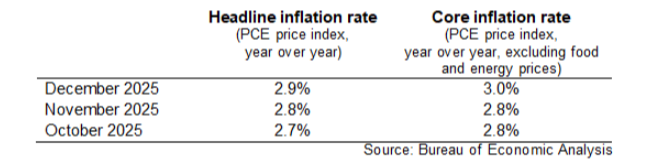
- Higher inflation in December. Last week, we learned that inflation accelerated in December. The personal consumption expenditures (PCE) price index, which is the Federal Reserve (Fed)’s preferred inflation measure, was delayed due to the government shutdown.
Unabated uncertainty around artificial intelligence (AI). This wasn’t new news. Investors have been struggling to understand the outlook for artificial intelligence for several weeks. They’re concerned about how AI will change business models, and whether the capital being spent on expansion will deliver attractive returns, reported Rita Nazareth of Bloomberg.
Supreme Court ruling on global tariffs. “The Supreme Court has ruled against the tariffs that President Donald Trump imposed under the International Emergency Economic Powers Act…The president has responded, saying he will continue his tariff regime, using different legal authorities. A first step is a 10 [percent] global tariff, in addition to existing levies, he said,” reported Barron’s.
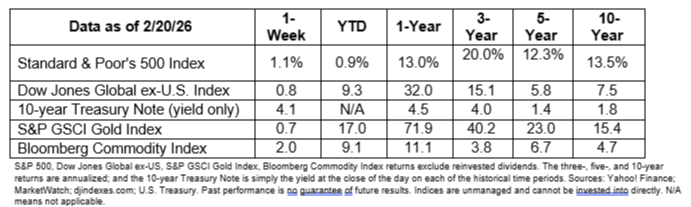
The U.S. stock market offered a bumpy ride last week, but major U.S. stock indexes finished higher. Yields on most maturities of U.S. Treasuries ended the week higher.
A CHANGE IN LEADERSHIP. The Fed is the central bank of the United States. It is responsible for keeping the financial system running smoothly. In 2026, the Fed will see its leadership change. The current chair will retire, and former Fed Governor Kevin Warsh has been nominated to replace him.
A new approach to monetary policy
Mr. Warsh is a vocal critic of certain Fed policies. He has argued that quantitative easing (QE), which is the Fed’s practice of purchasing U.S. government bonds to stabilize the financial system, encouraged Congress to spend more than it otherwise might have.
In an April 2025 lecture, Warsh explained:
“In the 2008 crisis, we cut interest rates to near zero and sought new ways to make monetary policy looser and bring liquidity to illiquid markets. I strongly supported this crisis-time innovation, then and now. But when the crisis ended, the Fed never retraced its steps…QE – with some fits and starts in the 2010s – has become a near permanent feature of central bank power and policy. Fiscal policymakers – that is, elected members of Congress – found it considerably easier appropriating money knowing that the government’s financing costs would be subsidized by the central bank.”
Retracing the Fed’s steps
One of Warsh’s priorities as Fed Chair may be reducing the central bank’s balance sheet, and there has considerable speculation about how this might be accomplished. Alex Harris of Bloomberg reported on several possibilities. These included:
- Reducing Treasury purchases. The Fed ended its latest round of quantitative tightening (QT) in December because bank reserves (the cash banks are required to keep on hand to ensure the stability of the system) were falling too low, creating stress in the system. The stress became significant enough that the Fed resumed bond purchases.
“While restarting QT is unlikely, the Fed could gradually reduce the pace of T-bill purchases from $40 billion a month currently, or stop them altogether,” according to analysts cited by Harris.
- Changing regulations. If bank reserve requirements were modified, the effect of QT on bank reserves could be reduced. “Regulators could relax the liquidity coverage ratio or internal liquidity stress test requirements, so lenders need to hold less cash,” suggested bank strategists cited by Harris.
- Exchanging assets. Another option is for the Fed to sell longer-term Treasuries and buy shorter-term Treasury bills, which mature in 12 months or less. “But without close coordination with Treasury, long-dated debt issuance needs and costs would rise significantly as the Fed retreats,” wrote Harris. One estimate suggested the change could push “borrowing costs up by 40 to 50 basis points.”
Warsh has expressed support for a more coordinated approach between the Fed and the U.S. Treasury Department, which could help mitigate the effects of Fed balance sheet reduction efforts, according to Ye Xie, Michael MacKenzie, and Maria Eloisa Capurro of Bloomberg. However, greater coordination could also raise questions about whether the Fed is acting independently.
The Fed will face another significant challenge during Warsh’s tenure: managing monetary policy in an economy being transformed by AI. We’ll explore that next week.
WEEKLY FOCUS – THINK ABOUT IT
“Courage is what it takes to stand up and speak; courage is also what it takes to sit down and listen.”
– Winston Churchill, Former British Prime Minister
Best regards,
Greg Clifton, ChFC, CFP®, MBA
P.S. Please feel free to forward this commentary to family, friends or colleagues. If you would like us to add them to the list, please reply to this email with their email address and we will ask for their permission to be added.
Securities offered through Registered Representatives of Cambridge Investment Research, Inc., a broker-dealer, member FINRA/SIPC. Advisory services offered through Cambridge Investment Research Advisors, Inc., a Registered Investment Advisor. Clifton Capital Advisors, LLC and Cambridge are not affiliated.
* These views are those of Carson Coaching, not the presenting Representative, the Representative’s Broker/Dealer, or Registered Investment Advisor, and should not be construed as investment advice.
* This newsletter was prepared by Carson Coaching. Carson Coaching is not affiliated with the named firm or broker/dealer.
* Government bonds and Treasury Bills are guaranteed by the U.S. government as to the timely payment of principal and interest and, if held to maturity, offer a fixed rate of return and fixed principal value. However, the value of fund shares is not guaranteed and will fluctuate.
* Corporate bonds are considered higher risk than government bonds but normally offer a higher yield and are subject to market, interest rate and credit risk as well as additional risks based on the quality of issuer coupon rate, price, yield, maturity, and redemption features.
* The Standard & Poor's 500 (S&P 500) is an unmanaged group of securities considered to be representative of the stock market in general. You cannot invest directly in this index.
* All indexes referenced are unmanaged. The volatility of indexes could be materially different from that of a client’s portfolio. Unmanaged index returns do not reflect fees, expenses, or sales charges. Index performance is not indicative of the performance of any investment. You cannot invest directly in an index.
* The Dow Jones Global ex-U.S. Index covers approximately 95% of the market capitalization of the 45 developed and emerging countries included in the Index.
* The 10-year Treasury Note represents debt owed by the United States Treasury to the public. Since the U.S. Government is seen as a risk-free borrower, investors use the 10-year Treasury Note as a benchmark for the long-term bond market.
* Gold represents the 3:00 p.m. (London time) gold price as reported by the London Bullion Market Association and is expressed in U.S. Dollars per fine troy ounce. The source for gold data is Federal Reserve Bank of St. Louis (FRED), https://fred.stlouisfed.org/series/GOLDPMGBD228NLBM.
* The Bloomberg Commodity Index is designed to be a highly liquid and diversified benchmark for the commodity futures market. The Index is composed of futures contracts on 19 physical commodities and was launched on July 14, 1998.
* The DJ Equity All REIT Total Return Index measures the total return performance of the equity subcategory of the Real Estate Investment Trust (REIT) industry as calculated by Dow Jones.
* The Dow Jones Industrial Average (DJIA), commonly known as “The Dow,” is an index representing 30 stock of companies maintained and reviewed by the editors of The Wall Street Journal.
* The NASDAQ Composite is an unmanaged index of securities traded on the NASDAQ system.
* International investing involves special risks such as currency fluctuation and political instability and may not be suitable for all investors. These risks are often heightened for investments in emerging markets.
* Yahoo! Finance is the source for any reference to the performance of an index between two specific periods.
* The risk of loss in trading commodities and futures can be substantial. You should therefore carefully consider whether such trading is suitable for you in light of your financial condition. The high degree of leverage is often obtainable in commodity trading and can work against you as well as for you. The use of leverage can lead to large losses as well as gains.
* Opinions expressed are subject to change without notice and are not intended as investment advice or to predict future performance.
* Economic forecasts set forth may not develop as predicted and there can be no guarantee that strategies promoted will be successful.
* Past performance does not guarantee future results. Investing involves risk, including loss of principal.
* The foregoing information has been obtained from sources considered to be reliable, but we do not guarantee it is accurate or complete.
* There is no guarantee a diversified portfolio will enhance overall returns or outperform a non-diversified portfolio. Diversification does not protect against market risk.
* Asset allocation does not ensure a profit or protect against a loss.
* Consult your financial professional before making any investment decision.
Sources:
https://www.cnbc.com/2026/02/20/pce-inflation-december-2025.html
https://www.bea.gov/news/2026/personal-income-and-outlays-december-2025 [Table 2.8.11, lines 32 and 37]
https://www.bloomberg.com/news/articles/2026-02-16/asian-stocks-set-for-muted-start-in-holiday-trade-markets-wrap? or go tohttps://resources.carsongroup.com/hubfs/WMC-Source/2026/02-23-26-Bloomberg-Stocks-Whipsaw-as-AI%20-%204.pdf
https://www.barrons.com/livecoverage/trump-tariffs-scotus-ruling?mod=hp_LEDE_A_1or go tohttps://resources.carsongroup.com/hubfs/WMC-Source/2026/02-23-26-Barrons-Trump-Plans-New%20-%205.pdf
https://www.barrons.com/market-data?mod=BOL_TOPNAVor go to https://resources.carsongroup.com/hubfs/WMC-Source/2026/02-23-26-Barrons-DJIA-S&P-Nasdaq%20-%206.pdf
https://www.bloomberg.com/news/articles/2026-02-17/wall-street-is-sizing-up-warsh-s-options-to-shrink-fed-portfolioor go tohttps://resources.carsongroup.com/hubfs/WMC-Source/2026/02-23-26-Bloomberg-Wall-Street-is-Sizing-Up%20-%2010.pdf
https://fred.stlouisfed.org/series/WALCLor go tohttps://resources.carsongroup.com/hubfs/WMC-Source/2026/02-23-26-Federal-Reserve-Bank-of-St-Louis%20-%2011.pdf
https://www.federalreserve.gov/newsevents/speech/jefferson20260116a.htm
https://www.bloomberg.com/news/articles/2026-02-08/warsh-call-for-fed-treasury-accord-stirs-debate-bond-marketor go tohttps://resources.carsongroup.com/hubfs/WMC-Source/2026/02-23-26-Bloomberg-Warsh-Call-For-Fed-Treasury%20-%2013.pdf
https://www.brainyquote.com/quotes/winston_churchill_161628?src=t_courage
